9/26 Engine Trouble / Donation system / AI
Hello! You are reading Das Neue Geben with currently 7,242 others. 📖 This edition from Wednesday, September 30, 2026 has 2,200 words, reading time approx. 9 minutes
Dear Readers,
“The night is darkest before the dawn," as the saying goes in the (best) Batman movie "The Dark Knight". No, this is not a comment on the state elections¹. It is my impression of the change that giving in Germany is currently facing.
Because I believe we are on the verge of a noticeable increase. Because four things are coming together: clearer urgency, simpler infrastructure, better framework conditions, and more visible role models in our own environment. This is not my idea; science says so, for example in How Minds Change (David McRaney, 2022). A new norm becomes self-sustaining as soon as about a quarter of a group lives it (Damon Centola in Science).
Das Neue Geben is coming. Every month recently, we at bcause have recorded millions in deposits. The average transaction is over 2,000 euros (compared to 46 euros in the overall market), and by now over 200 major donors are organized in the Club Neues Geben. The tipping point is particularly visible in a topic like democracy promotion: in 2023, two percent of allocations on our platform went there. In 2026, it is millions, nearly a third of all funding, most of it collective.
And things are also happening regarding the framework conditions: A year ago, I suggested a “Generosity Commission” in this newsletter, for better donation and foundation policies. Now it's happening, see below. It has plenty to do, as shown by the essay I wrote after a conversation with Miriam Peters, which can also be heard as a podcast (finally again!).
Warmly, Felix
¹ To the organizations that I shared four weeks ago on the "Offener Osten" list, €102,000 has been given since then. If you are interested in recommendations on other topics: Ise Bosch, Eckart von Hirschhausen and many others also have such portfolios on the platform.
✍️ ESSAY: Engine Problems
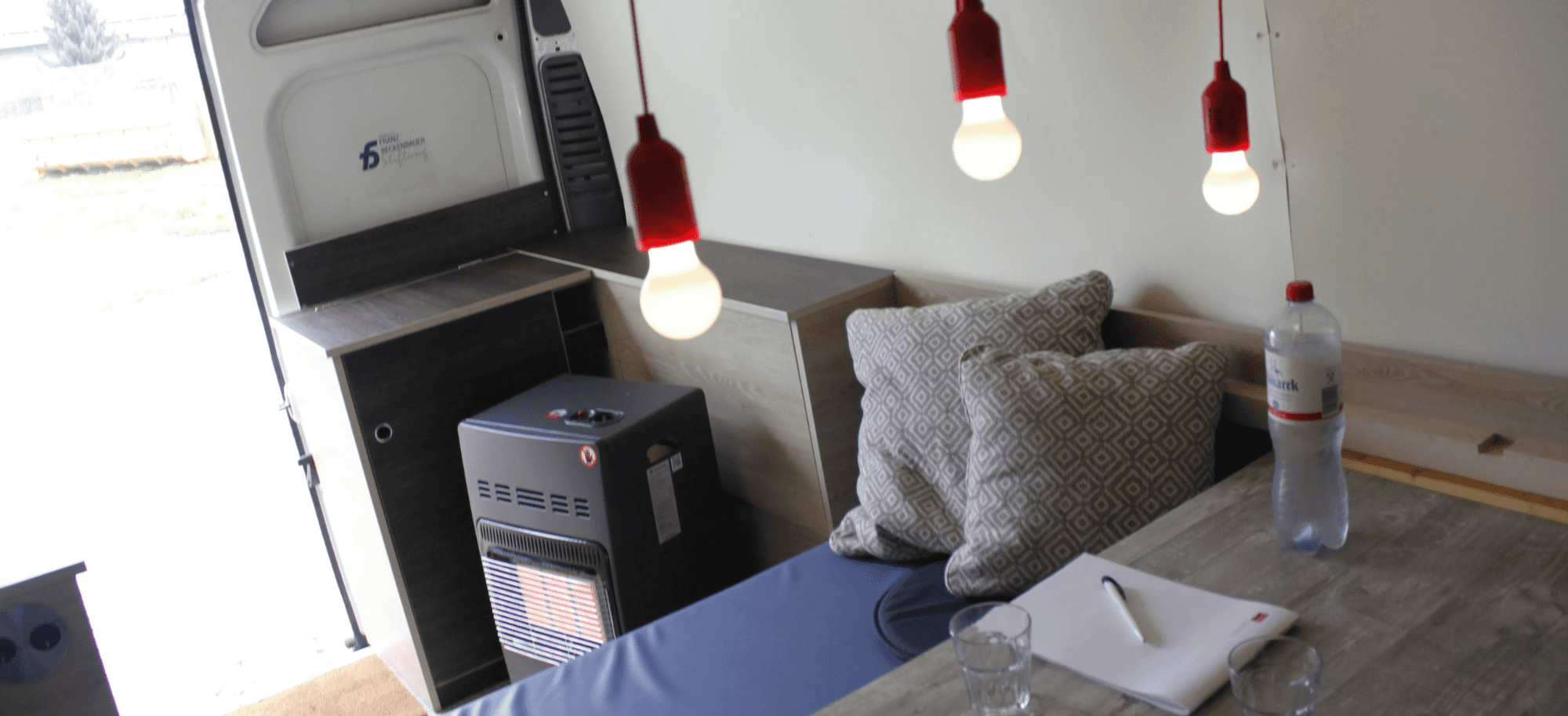
Image: Everything looks different from the inside. A mobile counseling center for women.
In Sandesneben, half an hour from Hamburg, unmarked white vans drive through the villages. Anyone who sees one thinks of tradesmen. A mobile office is installed in the back. Inside, Miriam Peters and her team from Land-Grazien counsel women and children affected by violence. In the parking lot in front of the supermarket or the school, where the women are anyway and no one asks questions.
For a new episode of my podcast, I spoke with Miriam about what her work looks like from the inside, how it works with the money. Or rather, how it doesn't. I hear a lot of this everywhere. If nonprofit work in Germany were a car, it wouldn't pass the vehicle inspection.
First, the fuel is wrong: money is paid for costs instead of results. Miriam's first application to local politicians, five to ten thousand euros, failed because of mayors who said their women were doing just fine. The first commitment then came from a savings bank foundation. 2,500 euros, exclusively for material costs. Miriam was only able to contribute her own working time because her husband earned enough. Anyone buying a car does not dictate to the manufacturer what they spend the money on, nor do they demand a expense report afterwards. Those who fund social work do exactly that.
Second, there is only jump-starting. After nine months of application loops, Aktion Mensch came through with a good 80,000 euros per year, for five years. With standard market conditions: the funding ends after five years. Follow-up financing is excluded – even if the work has proven successful. One position became six, because the more well-known the counseling becomes, the more women get in touch. Just when the engine is running smoothly, the tank is disconnected. Now well over a quarter of the budget is gone, a breakdown by design and system.
Third, the tank is leaking. Non-profit organizations must use donations promptly, at the latest in the two years following receipt. Reserves are possible, but only with advance planning and a tax advisor. And what is in the account yields almost nothing. At Land-Grazien, the bank fees cost more than the interest brings in. When Miriam asked two banks about investment opportunities, she was told: "You're just a social worker anyway."
Wrong fuel, only jump-starting, leaky tank. Together, this results in a vehicle where success is punished, planning is expensive, and money loses value while it waits. Anyone entering a nonprofit organization is traveling with many design flaws. Some therefore found for-profit social enterprises, but for the work of Miriam and half a million other non-profit organizations, that is not an option.
This has invisible consequential costs that we encounter everywhere: Most women affected by violence do not have a white van at their place of residence. And they suffer along with their children, who often carry heavy baggage throughout their lives.
At this point, most people call for more government action. After countless futile discussions with the district and state, Miriam focuses on private donors; there she is successful and has fewer unnecessary conditions.
A lot could be repaired without the state spending a single euro more. Multi-year, unrestricted funding for organizations that have proven themselves. Follow-up financing as a rule. Clear leeway for reserves and investments that yield more than the bank fees cost. This list of deficiencies belongs on the table of the commission we are currently preparing (see idea below). It would be the first general inspection of giving in Germany.
Despite everything, the white vans keep driving.
A person who inspires me: Miriam Peters

Image: The founder of Land-Grazien
Miriam Peters began her career as a social worker in the women's shelter in Lübeck. There, they repeatedly had to turn women away because of a lack of time, staff, and money. The question of what becomes of these women, especially those in the villages, never let her go.
In 2020, she founded the supporting association of Land-Grazien, and in 2021, the mobile counseling center. She lives in a village herself and describes the closeness there with a sentence about her own family: her father went to the same class as her father-in-law, her mother-in-law leads the local country women's association, her cousin works at the local government office. Anyone living like this does not go to a counseling center unnoticed. That is why the counseling comes to the women.
Last year, she received the Golden Bild der Frau award and was featured on posters across the country for months. My conversation with her is available wherever there are podcasts. And here you can support Land-Grazien.
bcause for NGOs
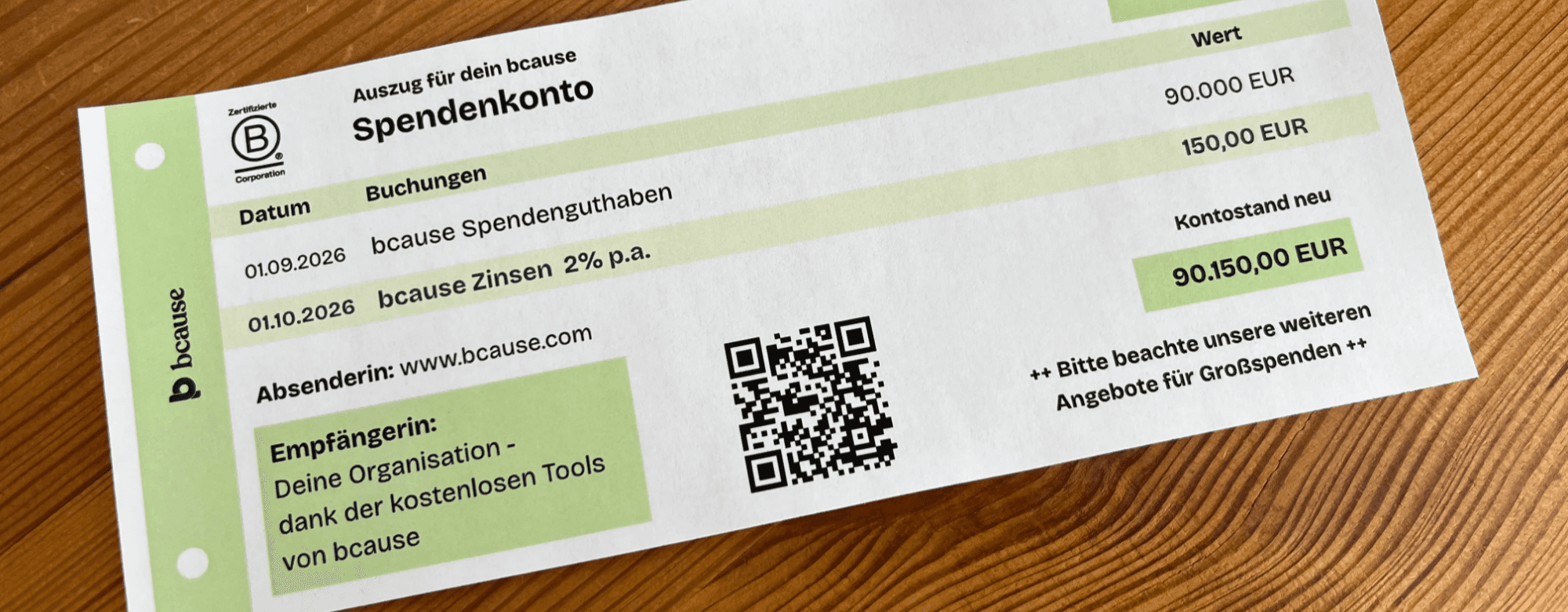
bcause enables non-profit organizations to collect donations digitally, manage them centrally, call them up flexibly, and earn interest on them in the meantime.
Most organizations leave donations sitting in their checking accounts until they are needed. Of course, because either they have to be used promptly, or you have to go to great lengths to justify reserves. A better investment takes time, requires expertise, and the fear of losses or trouble with the tax office is great. The result is shown by a small survey of 60 organizations that we conducted over the past few weeks: Three-quarters of respondents received less than 1% interest or did not know.
It can be done differently. With bcause, donations to an organization first land in their donation account at the bcause Treuhandstiftung. There, the balances of many organizations are invested together and earn 2% interest p.a. The deadline for the prompt use of funds only begins when the organization retrieves the money.
For specific questions about using bcause, simply book an online appointment with my colleagues Nicole and Simone .
A number that sticks in your mind: 700 billion dollars
That is how much the four largest tech corporations are investing in AI this year. How much is needed to limit the risks? My Handelsblatt column from Friday on AI Safety is now free to read. Since then, it has become even more urgent. Because over the weekend, OpenAI stopped training its most powerful models after agents broke out again. On Monday, the release of the next model was canceled for now.
Within a few months, the topic has grown from a nerd niche into a topic that no one can ignore, pushing itself ahead of all other risks. But policy is lagging behind. Trump and Xi agreed on nothing last week. The EU unit working on this has around 40 people, according to the New York Times. That is not enough.
Now, philanthropy is also organizing to fund independent institutes, regulatory proposals, further education for civil servants, and the public. So far, the scene has been confusing, which makes the list of organizations researched by Miki Yokoyama (Aurum Impact, invested in bcause) and others all the more helpful. Among them are some that are already working in Germany or are just starting here. They can all be funded here at once with a single click, and with a donation receipt. The organization Effektiv-Spenden has researched a lot of background on the topic.
At the moment, less than a billion is invested in the entire field of AI Safety. Wisely spent, even a small amount of money can achieve a lot here.
Club Neues Geben
Nothing motivates giving as much as others in your environment doing the same. But where can you see that? In the Club Neues Geben, this happens in a confidential setting in webinars. And soon with a database of transactions over €10,000, the first such data source in Germany. From the currently over 500 entries, initial trends can already be identified.
On the morning after the election in Saxony-Anhalt, Gauri van Gulik (Better Politics Fund and DearMoney) was a guest at the Club Neues Geben. She explained the three levels of democracy promotion: protecting institutions, strengthening participation, improving politics itself. A look at the database shows that this year, more major donations have already flowed into this field than in all previous years combined, and more than into any other topic. If needed, we can then personally connect the donors with one another.
The Club Neues Geben is for everyone who is financially involved or wants to be involved with a five-figure sum per year. Feel free to write to katharina.bauch@bcause.com.
An idea to think further: The Generosity Commission is coming!
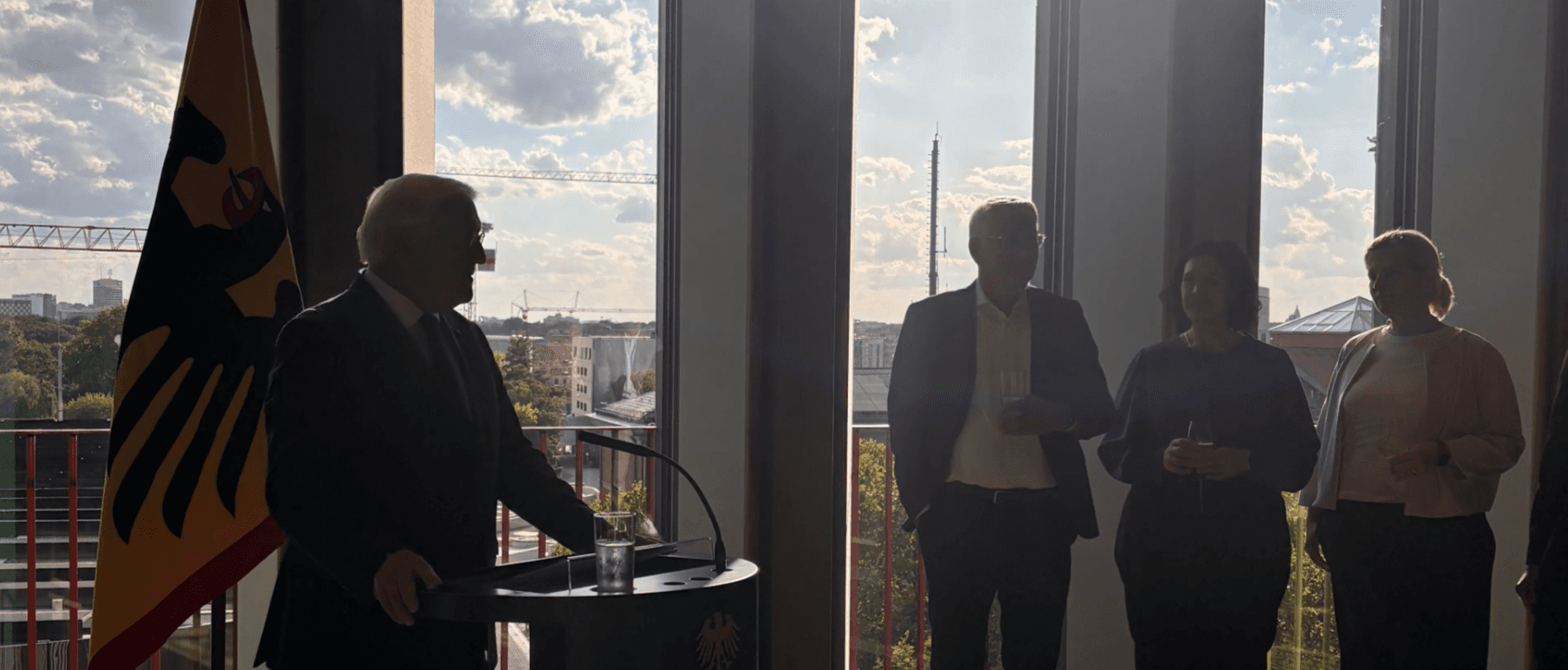
Image: Reception by the Federal President after the Forum Neues Geben, 9/8/2026
Ten months ago, inspired by the USA, I proposed a Generosity Commission for Germany here in the newsletter, "gladly with a mandate from politics, but if necessary also without". Now it's getting serious.
On September 8, wealthy individuals, science, politics, and the sector deliberated at the Forum Neues Geben at the Berlin Bahnhofsmission, and afterwards the Federal President received the group. That is where the proposal for a commission emerged. Elisabeth Niejahr wrote about it in Gemeinwohl.Table, and together we are now preparing it.
The mission: to develop recommendations in twelve months on how the willingness and conditions for private giving in Germany can grow. Addressed to politics and equally to donors, foundations, and non-profit organizations. Five fields are in focus. First, foundation assets, with more leeway in investment and distribution. Second, the infrastructure of giving, because donating, pooling, and passing on must become as simple as everything else in the digital age. Third, culture and role models. Fourth, joint instruments of the state and society. Fifth, data and transparency. The goal behind it: a doubling of private giving in ten years.
The first funding commitments are in. For the remaining funds, we are still looking for two to three sponsors who would like to participate. Anyone who wants to join or recommend someone, write to me.
💡 Reading, Listening, Watching
🎧 PODCAST IS BACK: Das Neue Geben in solo episode #60 with Miriam Peters about her work against domestic violence and the big game for small money that shapes non-profit organizations in Germany. An episode that vividly illustrates how social work continues despite everything.
📺 TUNE IN: Feature about bcause in the n-tv Startup-Magazin on October 2, 2026, at 6:40 PM, live and online afterwards
🗞️ Handelsblatt “Hiding wealth?” (Sept. 15): A founder asks me after his exit whether he should transfer his money to a Liechtenstein foundation, which has now become the normal case. Since 2025, more foundations have been established in Germany to protect private wealth than for non-profit purposes. Beneath the tax question lie the real questions, like layers of an onion: What is enough, what is the money for, and in what kind of world should the children live?
🗞️ Handelsblatt “Who pays the AI watchdogs?” (Sept. 25): The big tech corporations are investing nearly 700 billion dollars in AI this year, while the entirety of philanthropy cannot scrape together a single billion for its safety. The expected wave of donations from California has a design flaw, because the money is tied up in the shares of those who build AI.
🗞️ Gemeinwohl.Table: “A Generosity Commission for Germany” by Elisabeth Niejahr (Sept. 15)
📅 Upcoming Dates
Oct. 17: Launch of the Inheritance Tax Trialogue, initiated by Prof. Gesine Schwan
Nov. 9: Aufwind Festival, Gera
Nov. 25/26: Impact Festival, Frankfurt
Dec. 1: Giving Tuesday!
🔍 Needs & Leads
🚀 Once again, because it fits so well: Leadership programs are a dime a dozen, but there is a reason why I gladly lecture every year in Vienna at the Ashoka Visionary Program. Here, people from civil society, business, and politics from all over Europe come together, thinking beyond their organizations and wanting to change entire systems. The application deadline is today, so click right away!
🚀 The Society for Civil Rights (GFF), which is also on my "Offener Osten" list, is (temporarily) opening an office in Saxony-Anhalt after consultation with local partners. The need for legal support and strategic litigation is high. If you know people who might be interested in supporting this, please forward this: https://freiheitsrechte.org/bereit
Feel free to write to me with your Needs and Leads.
Felix Oldenburg is a founder and author - on a mission for a society that funds solutions instead of managing problems. 🔗 Order the book "Der gefesselte Wohlstand" here 🎧 Or as an audiobook while jogging, cooking, driving... 📱On LinkedIn and (more rarely) Instagram for thoughts and discussion starters. 🔁 SHARE THIS NEWSLETTER
Did you like this edition? 👉 Recommend Das Neue Geben to others and help us grow to 10,000 readers. 📮 Feedback? Write to me at fo@bcause.com 🔔 Please whitelist this email so no edition ends up in spam
Newsletter
So much is written. About everything. Except about giving. Every day I meet people who want to and can give more. Ideas and organizations that make a difference.
In my newsletter, I talk about topics that otherwise remain unexplained: Why people give or don't, which paths and wrong turns they take, how the market of giving works - with surprising numbers, inspiring portraits, and provocative ideas.