7/26 Odyssey / Donation Wave / Middle Way
Hello! You are reading Das Neue Geben with currently 6,974 others. 📖 This edition of Thursday, July 30, 2026 has 1,997 words, reading time approx. 10 minutes
Dear readers,
This newsletter comes from the USA, and it is packed with insights. In New York, I spoke with two major donors and was admitted into the P150 group of globally leading philanthropy consultants; in Washington DC, I discussed with non-profit experts who are preparing for a "third wave" of US philanthropy (see below); and in Miami, I am currently experiencing a city that has completely transformed since the pandemic into one of the global attraction points for the wealthy and their giving.
But it would be too easy to write with wide eyes from the "Promised Land" of philanthropy. Neither my children nor I would want to swap. And the most beautiful experiences of these weeks were in the laundromat, at the pinball machine, and in a church service.
My essay is also not about my own journey, but about the oldest travelogue of humanity. In the widest cinema seat I have ever sat in, I saw "Odyssey" by Christopher Nolan (speaking of wide eyes), and a punchline in it impressed me deeply.
Furthermore, starting from a discussion triggered by my column in the Handelsblatt, I wonder for whom taxes have become voluntary, celebrate new billion-dollar commitments, and am delighted about the largest single deposit on bcause to date.
Warmly, Felix
✍️ ESSAY: Are We The Sea People?

Image: A golden olive wreath in the Troy Museum, photographed April 2026
The end of civilization is nothing new, which is worth remembering in light of some contemporary discussions. A few weeks ago, I stood on the hill of Troy at the entrance to the Dardanelles and found amateur videos on YouTube that give an impression of how magical the Iliad and the Odyssey sounded when they were passed down by singers nearly three thousand years ago.
The human catastrophe that Homer recalls is the mysterious downfall of several advanced civilizations hundreds of years earlier at the hands of predatory "Sea Peoples". Christopher Nolan leaves nothing out; his Odysseus must of course escape the Cyclops, resist the sirens' temptations, free his men turned into pigs by greed, and find the needle's eye between the marine hazards of Scylla and Charybdis. That was my favorite scene as a child.
What I am only realizing now: the epic is actually about the law of hospitality, Zeus's protection of strangers, who are to be treated as one would wish to be treated oneself. Nolan places this variation of the golden rule in every scene. And he adds a punchline: after Odysseus' return to Ithaca, the principled Penelope asks, looking with devastating clarity at the Greek princes eaten away by excess and jealousy: "Are WE the sea people?"
For Homer, Troy did not fall because barbarians destroyed it. It was the glorified Greeks for whom he spun a triumphant story. Penelope's question is not in the text, but it is so good that I wonder if the whole story is not a Trojan horse for this insight.
After every civilizational catastrophe, humanity has recovered, built something new, often citing the best of an idealized past. I can understand that even today there are many who say it won't be that bad. In the last newsletter, I asked how high the walls of wealth must be when fires are burning in more and more places. Today, huge clouds of smoke are drifting over Europe and the USA.
In Homer's time, Greece was densely forested. Climate change is nothing new either, one could say. It is tempting to believe that everything will just work itself out. But unlike the Homeric gods, global warming cannot be negotiated with. The strangers whose livelihoods we are destroying by not sharing are already living today.
Nolan's film grossed 124 million dollars in its opening weekend in the US alone, my 15-dollar ticket included. Perhaps it is a blockbuster, of all things, that helps many people answer the big question "What should we do?" with very individual generosity towards strangers. No matter what golden laurel wreaths we walk around with, without them, we are barbarians.
A person who inspires me Melanie Perkins
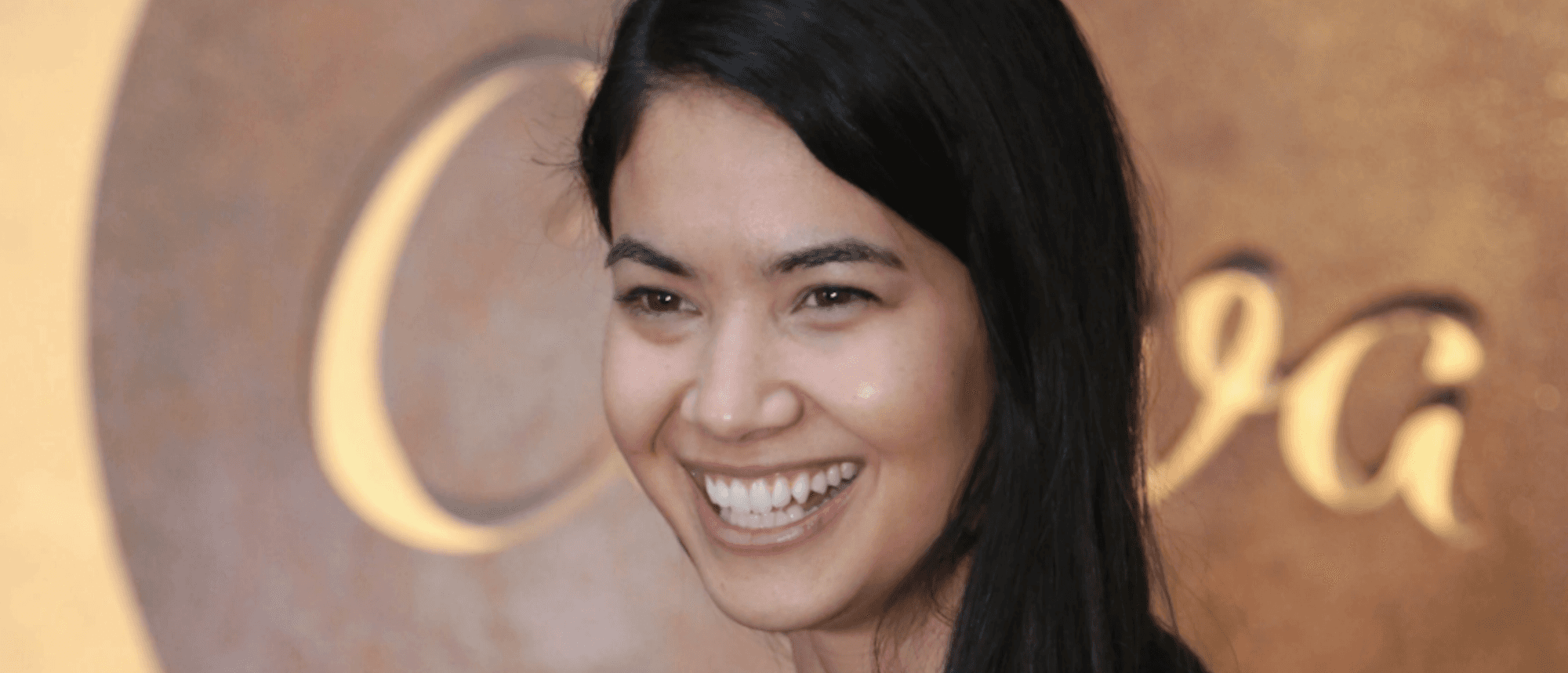
Image: Melanie Perkins, Australian Canva co-founder
One of the largest announced wealth donations in the anticipated tech philanthropy wave is taking shape: Canva co-founder Melanie Perkins and her husband Cliff Obrecht want to dedicate more than 80 percent of their joint wealth to charitable causes. Currently, this amounts to more than 12 billion US dollars, about 30 percent of the total Canva value for their foundation. On July 17, they launched the Global Goals Platform: people are asked to state what goal they would like to see achieved in their lifetime; initial pilot projects are running in the USA and in Wollongong, Australia, with the results to be published at the end of 2026. In parallel, the Canva Foundation has pledged a total of 150 million US dollars for direct cash transfers in Malawi: more than 130,000 people have already been reached, and another 185,000 adults are expected to receive payments over the next four years.
The sums announced in the coming months could be even larger. Several of the seven Anthropic founders pledged years ago to donate 80% of their wealth, which initial calculations estimate at over 86 billion dollars. The OpenAI Foundation holds a stake of around 130 billion dollars. The fact that money is being moved right now has a lot to do with taxes: in a liquidity event, it is particularly attractive for wealthy US tech individuals to contribute highly valued stocks or shares directly to charity instead of selling them first. However, the wave will look less like traditional donations and will instead involve transfers to philanthropic vehicles like Donor Advised Funds. When the money flows to organizations was one of the major discussion points at the United Philanthropy Infrastructure Forum in Washington DC, which was part of my trip.
bcause for Organizations
bcause enables non-profit organizations to collect donations digitally, manage them centrally, access them flexibly – and earn interest on them in the meantime. Major donations are the greatest hope for many organizations. But how does that work in practice? How do you approach the strategy, open up networks, use the presence on bcause, the interest on balances, and the fundraising tools?
This is exactly where a new partnership with neues-stiften comes in. In four compact online hours, Andreas Schiemenz, one of the most experienced major donor consultants in the German-speaking area, guides you through the central success factors.
The seminar is aimed at organizations that want to build up their major donor program in a targeted manner. Four hours, 750 euros, registration here
Or for specific questions about using bcause, simply book an online appointment with my colleagues Nicole and Simone .
A number that sticks in your mind €1.9M
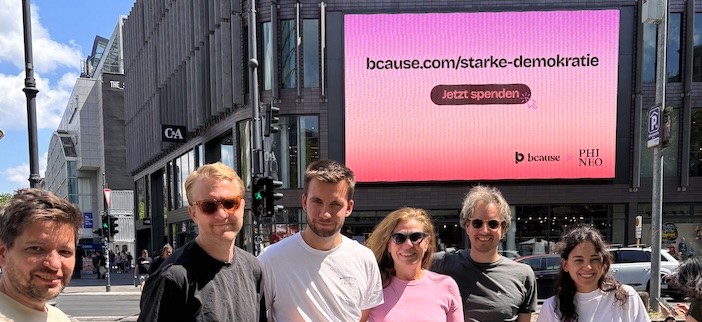
Image: Donation advertising for democracy funds on Kudamm
The largest single deposit on bcause to date reached us in July. While this is not yet on the scale of US donations, it proves once again that online platforms are not only used for smaller transactions (in total, over 4.5 million donations were paid into bcause accounts in July).
Unlike in Germany, it rarely took me more than a minute to explain bcause in the US. In principle, the model is what is known as a Donor Advised Fund, which has absorbed far larger sums than traditional foundations in recent years. The payout rate is significantly higher, management is simpler, and costs are lower. Nevertheless, these funds face criticism, especially when managed by banks for whom distributing the money is not a priority.
And here, the bcause model deliberately diverges from the US prototype in two ways: we do not prioritize tax incentives or returns (although that would be tempting), but rather the good causes the money is meant to support. And this is bigger than ever: the giant display on Berlin's Ku'damm is currently showing the Democracy Fund, which we set up with PHINEO, right between advertisements for the latest mobile phones and clothing brands.
Club Neues Geben
At bcause, Professional members have the opportunity to participate in the asset investment of the bcause Treuhandstiftung with their donation balance
This means: deposited donation balances, for which the decision on utilization is still pending, do not just lie around, but can already actively make an impact. In our multi-asset portfolio, which is broadly diversified across impact funds and companies. While donation balance is invested there, it works.
In the first full year since sharing this offer with our users, the portfolio achieved +6.97% net p.a. The returns flow back proportionally to the foundation accounts as additional balance for further funding.
About half of the capital flows directly as primary capital into 31 impact positions: climate, social issues, mental health.
More about bcause Impact and the opportunity to participate with your own assets in the webinar on Sept 21 with our Head of Finance Marvin Wiek and expert Wiebke Merbeth from our investment advisory board. 📆 For registration: https://lnkd.in/gfqbrKAV We offer other formats for knowledge and exchange for people who want to engage with larger sums twice a month as part of our Club Neues Geben. Feel free to write to katharina.bauch@bcause.com if you are interested. Exclusive to givers, no fundraising.
More about the Club Neues Geben
An idea to think further Voluntary taxes?
My recent Handelsblatt column on tax advisors triggered an unusual amount of resonance. Apparently, it touches a raw nerve: if large fortunes can be structured with enough advice so that hardly any inheritance tax is due, are taxes then factually voluntary for a part of society? Not the tax liability itself, but certainly the decision of how much one actually pays.
There may be more behind this than the desire to keep as much as possible. Despite all cultural differences, many people in Germany and the USA share the conviction that they can decide better than the state what their money should be used for. Trust in state institutions is limited; at the same time, most have very specific ideas of what would be important to them. Perhaps that is why there is a hitherto barely tapped space between tax payment and tax avoidance: people certainly want to contribute to the community – but they want to see and help decide what comes of it.
Why not make a small, equal portion of the tax for everyone into a citizens' budget? The state would still decide on the amount and permissible purposes, but taxpayers could allocate a share to, say, education, climate protection, or care, and track digitally what happens with it. In Spain, it is already possible to designate 0.7 percent of income tax for social purposes without changing one's own tax burden. In France, company pension schemes must at least allow investment in a solidarity fund. This is not yet a democratic reorganization of the tax system. But it points to a middle way: away from tax as "damage," toward a contribution that feels like sharing with the community again.
💡 MORE FROM FELIX
Opening article for Gemeinwohl-Table “Why Germany needs a new culture of giving” (July 22)
Handelsblatt columns on Elon Musk (July 9) and on ethical tax advising (July 23)
Interview (June 9) with SIGU platform
Podcast “Responsibility - beyond blame and control” (July 26) in “Der Coach-Doc” with Kai Kochmann
📅 Upcoming appearances:
Aug 27 IHK Berlin “Financing in the Social Economy”
Sept 8 Forum and Reception Neues Geben, Berlin
Sept 14 Augenhöhe-Forum, Osnabrück → The inspiring story of host Karsten Wulf from founder to impact investor here on Spotify
Sept 15 The Frontier Dinner, with Renaissance Philanthropy, Zurich
Sept 15 Brains on Silicon, Dresden
Oct 12 Annual Conference of the Federal Association for Sustainable Economy
🔍 Needs & Leads
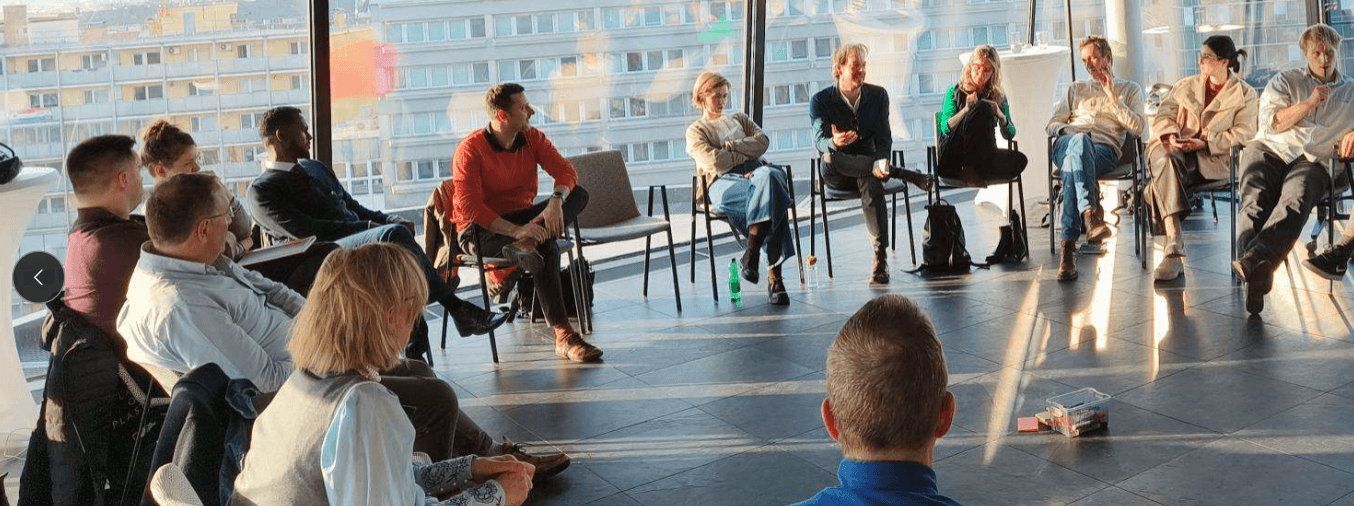
Image: At the Ashoka Visionary Program, Vienna, March 2026
Leadership programs abound, but there is a reason why I enjoy lecturing every year in Vienna at the Ashoka Visionary Program: here, people from civil society, business, and politics from all over Europe come together who think beyond their organizations and want to change entire systems.
Finally, there is an impact investing conference in Berlin: Impact becomes mainstream with PHINEO among others on Sept 10 in Berlin
The Campact petition "Equal pay for equal work NOW" by Silke Georgi ensures that the EU Pay Transparency Directive is finally implemented into German law - and thus finally effective instruments for real pay equity.
The CSP offers with the Nextgen Impact Investing Program currently the leading further education for asset owners from all over the world who want to deal with the impact of their capital. Quite a few members of the Club Neues Geben have already benefited from this.
Feel free to write to me with your needs and leads.
Felix Oldenburg is an initiator in the field of social entrepreneurship and foundations. 🔗 Order the book "Der gefesselte Wohlstand" here 🎧 Or as an audiobook while jogging, cooking, driving... 📱On Instagram and LinkedIn for daily thoughts and discussion starters.
Did you like this edition? 👉 Recommend Das Neue Geben further and help us grow to 10,000 readers. 📮 Feedback? Write to me at fo@bcause.com 🔔 Whitelist this email so that no edition lands in spam
Felix Oldenburg CEO bcause · Board member gut.org · Author "Der gefesselte Wohlstand"
Newsletter
So much is written. About everything. Except about giving. Every day I meet people who want to and can give more. Ideas and organizations that make a difference.
In my newsletter, I talk about topics that otherwise remain unexplained: Why people give or don't, which paths and wrong turns they take, how the market of giving works - with surprising numbers, inspiring portraits, and provocative ideas.