3/26 Privilege issues!
Hello! You are reading Das Neue Geben with currently 5,915 others. 📖 This Thursday, March 26, 2026 issue has approx. 1,740 words · reading time ~7 minutes
“Actually, I’ve spent my entire career helping others improve the world...” was my first thought when I learned that I had once again been selected among the three finalists for Impact Entrepreneur of the Year at the German Startup Awards. To be honest, the sentence has a second part: “... and I’d really love to win this time.” Maybe you could help me in the public voting? That would give our mission some tailwinds. Voting for the German Startup Awards
Speaking of honest, I was also honest with the confession in the Handelsblatt about being a bit disappointed. Because with a campaign for Women's Day on March 8, I initially couldn't find enough men whose donations to women's rights I wanted to double. But then it did work out: with my €5,000, it turned into almost €20,000. Thank you! This is particularly important in light of the current outcry on violence against women.
It's nice to be able to make a difference with my small public presence. It takes a little courage not to please everyone. The essay this week deals precisely with the contradictions of engaging with privileges. And that’s why I celebrate a privileged man who nevertheless makes himself visible.
Further below, I share a list of organizations in the areas of democracy and extremism that are affected by the brand-new funding freeze of the federal government, job advertisements, and a lecture on major donor fundraising.
Sincerely, Felix
PS: I’ve been asked a lot about the current pictures from Beirut. Terrible. Glad I was there. And I wonder: What other travel destinations exist today that will be impossible tomorrow?
✍️ ESSAY: Privilege Problems
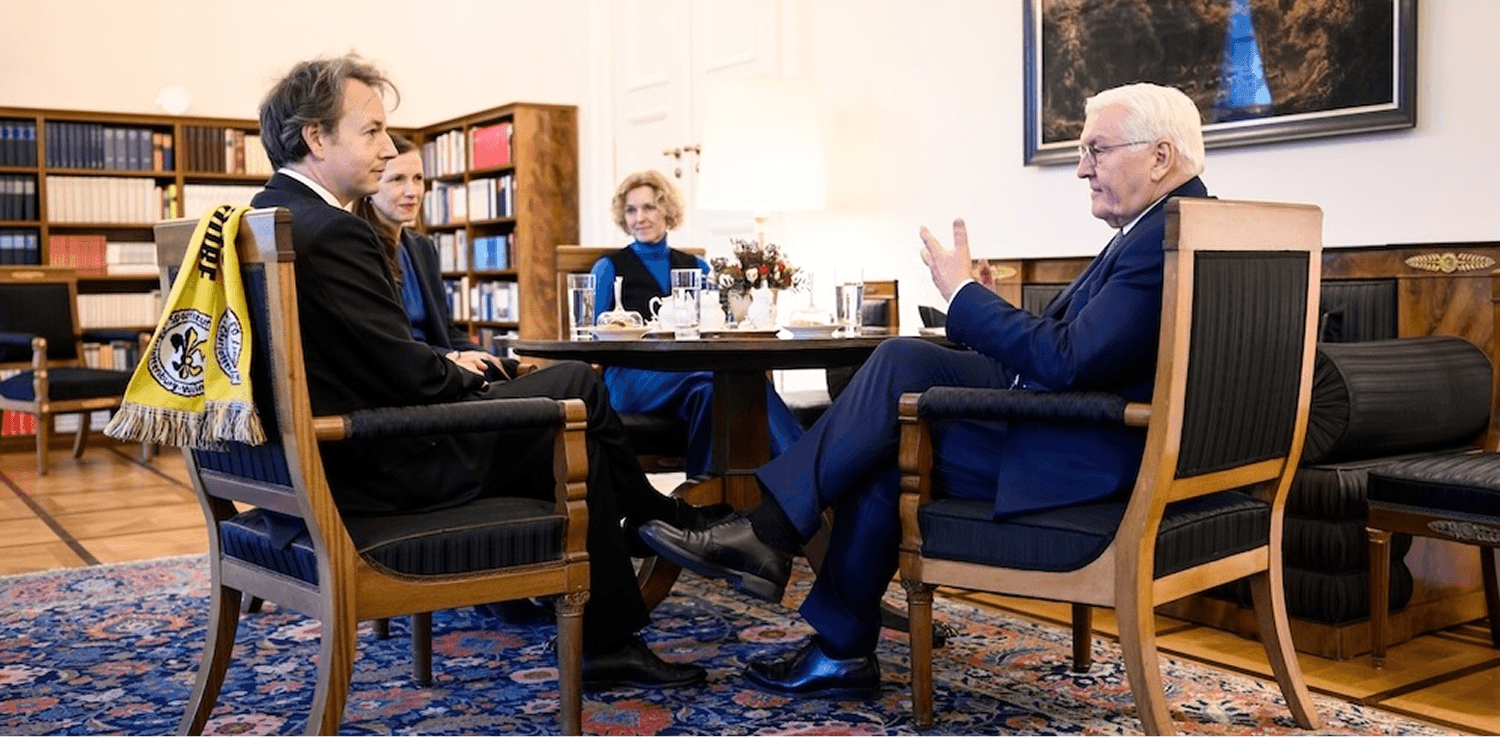
I move between very different worlds: wealth successors, startup founders, and DAX executives on the one hand, system-critical activists, social entrepreneurs, and guests at the train station mission on the other. Sometimes even in politics (see photo). Everyone wants to live in an open democracy, a nature worth living in. Yet we get entangled in debates about who is allowed to say and do what — instead of saying more and doing more.
I experienced this myself recently. For International Women's Day, I offered to double donations from men for women's rights. The result was sobering. Then I read a text by Emilia Roig, after which I felt half caught, half understood: men who present themselves publicly as feminists are rewarded by the system with precisely what women are fighting for — visibility, influence, credibility. The gap remains, just with better rhetoric.
The same pattern applies to philanthropy. Those who give receive recognition. Influence. Researchers at the University of Bath have proven this: elite philanthropy hardly leads to redistribution — it solidifies the social position of the givers. Giving becomes another accumulation of capital, just in a different currency. Motives and system effects are two different things.
Performative contradictions are everywhere. Those who mock wealth inequality most sharply often trust the state most strongly, even though it was exactly the state that helped build the criticized system in the first place. And what happens when only the state funds a field can currently be seen with the end of democracy promotion (see below) — and certainly if the AfD co-governs at the federal level.
It is a double stalemate. System critics need private money but would actually prefer not to have it — so they demand the state solution, even though they distrust the state. Many wealthy people want to act but fear showing themselves with their privileges. Both are waiting.
The recently deceased Jürgen Habermas described how democracy needs a shared public sphere — spaces in which arguments are exchanged and not just positions reinforced. This public sphere is eroding. Algorithms deliver confirmation instead of contradiction. Each side radicalizes in its corner.
Yet there is no giving without someone also being willing to receive. In my book “Der gefesselte Wohlstand”, which was published exactly one year ago, the epilog is about exactly that. I quote an Israeli friend saying that “to give” and “to receive” in Hebrew have the same root: nat. Translated: entrust.
This describes the actual challenge better than any political demand. How trust works is shown in the Prisoner's Dilemma: anyone who acts cynically on the assumption that the other only thinks of themselves anyway loses in the long run. Cooperation wins.
For wealthy people, this means in concrete terms: advocating for regulations that reduce privileges, directing resources to where decision-making power is shifted. That works. It might not bring applause. That's the point.
For the other side, it means: accepting money without actually judging the givers. Only in a climate in which privileged people are not criticized simply for having privileges does cooperation emerge — no applause necessary, but acceptance.
Club Neues Geben
Effective giving is a complex and personal task. The Club Neues Geben offers orientation and guidance through networking. No expensive consulting. No fundraising. Instead, personal experiences and knowledge.
Last week we had a well-attended webinar in which a club member shared her motivating experiences with the Climate Protection Donation Circle. In fact, there is hardly a more effective form of giving together than giving circles: a group meets (mostly online), one or two invited organizations present their work, and then everyone donates. Our partner organization Wider Sense has created a great study on this. By the way: a bcause Foundation is all it takes to get started within a few minutes. It automatically sends donation receipts and makes the distribution of donations simple.
An inspiring person: Kai Viehof
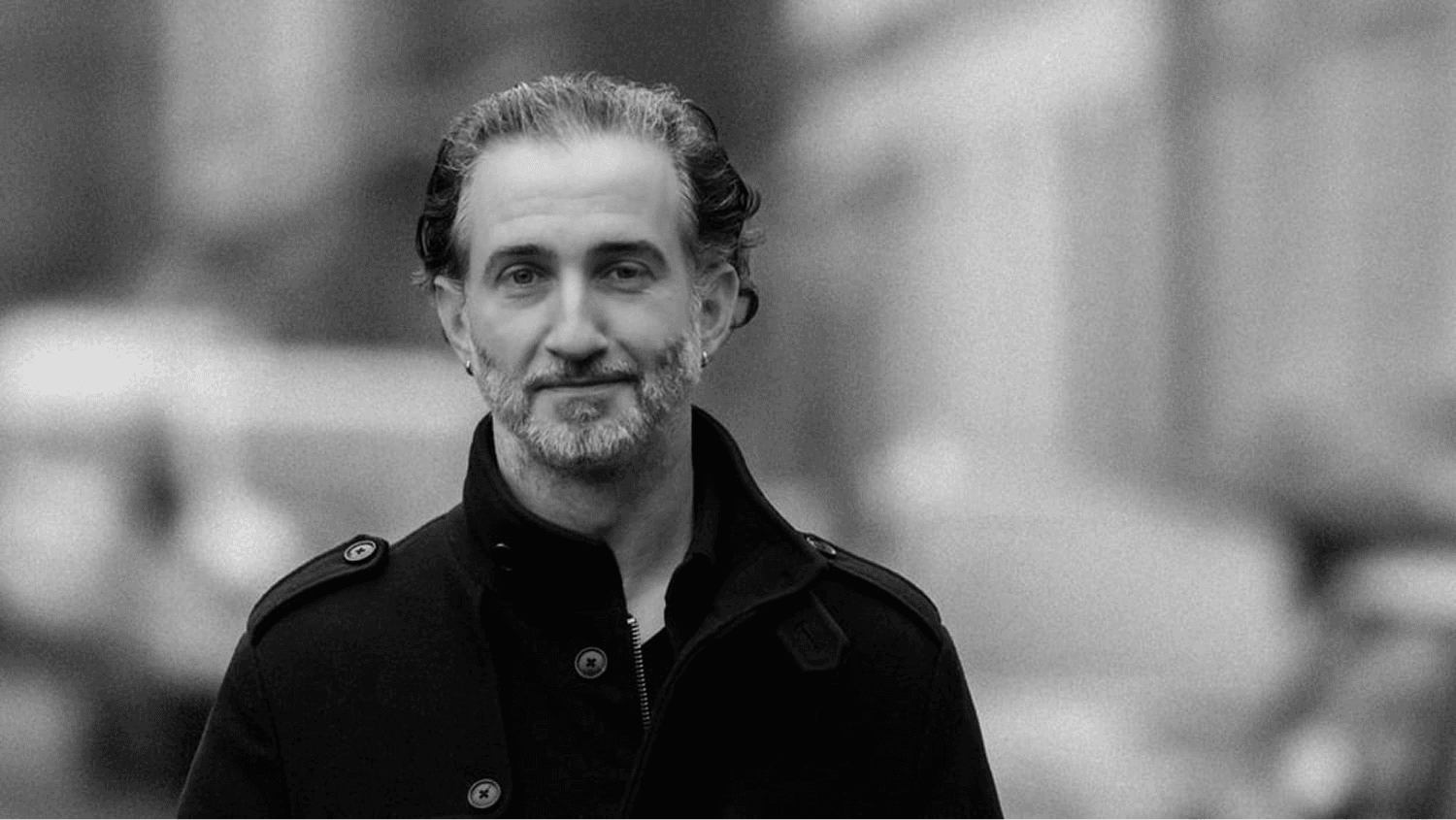
Kai Viehof, Photo: Luisa Sole
Every now and then, someone dares. The article about the “millionaire heir who doesn't want the millions” was the most read article in the Handelsblatt for a few days (and by the way, my column “How asset managers are losing the next generation” was in second place a week earlier). The Allkauf heir and trained tax advisor Kai Viehof (44) reflects a learning journey that is encouraging: from dealing with an unearned inheritance to exchanging ideas with like-minded people to supporting organizations working towards a different capitalism and also towards an open democracy. And on women's rights (see above). On the day of publication, we met spontaneously in Düsseldorf. And we experienced what a beautiful connection there is in giving together.
An idea for further thought: Extremism Prevention
Actually, I wanted to share a list of educational organizations that impressed me today. But then came the news of the funding freeze in the “Live Democracy!” program, which threatens the existence of many organizations working on human rights and extremism prevention. And because sometimes things have to happen quickly, I created a first list of relevant and affected organizations, almost all of which I know, with input from some knowledgeable people.
You can donate individually via the links or collectively through my small FO Foundation - I will then distribute the funds.
HateAid supports victims of digital violence with advice and legal assistance, and campaigns politically for better protection and more responsibility for platforms.
CORRECTIV is the non-profit investigative journalism center that uncovers grievances, makes facts accessible, and strengthens the democratic public sphere.
Das NETTZ connects actors against online hate with the toneshift network and develops strategies for dealing with digital violence.
VPN (Violence Prevention Network) works with radicalized individuals and those at risk to assist them in leaving extremism and to strengthen democratic paths through counselling, prevention, and educational work.
The Amadeu Antonio Foundation campaigns against right-wing extremism, racism, and antisemitism, promotes local initiatives, and strengthens engagement for democracy, diversity, and the protection of those affected.
Frauenhauskoordinierung e.V. supports women's shelters nationwide, develops quality standards, and campaigns politically for better protection and support services.
Radikale Töchter encourages people to creatively stand up for democracy, and teaches activism as a shapeable practice through workshops and campaigns.
EOTO (Each One Teach One) is a community-based organization for Black people, which creates spaces for exchange and campaigns against racism and for participation.
ufuq.de does political education work with young people on Islam, Islamophobia, and radicalization, and strengthens democratic competencies as well as active social participation.
Not quite fitting into this list is the new German Fund for Democracy started by Campact and innn.it, but I would like to mention it anyway because from autumn it aims to specifically support organizations affected by the loss of state funding. Sometimes reality is even quicker.
A number that stays in your head 10,000
The other day, after a conversation with a donor, I created a calculation example. How much capital would he need to distribute €10,000 in funding annually from the earnings?
Of course, you don’t need your own legal foundation for this. But even for a trust foundation with a foundation administrator, the answer is surprisingly high. Typical foundation funds generate a net return of around 2–2.5% after costs. At the same time, additional fees are charged by the administrator: standard market rates are 3% on every distribution as well as fixed administrative costs of around 5,000 euros per year. To actually distribute 10,000 euros with these costs, you need around 650,000 euros in assets.
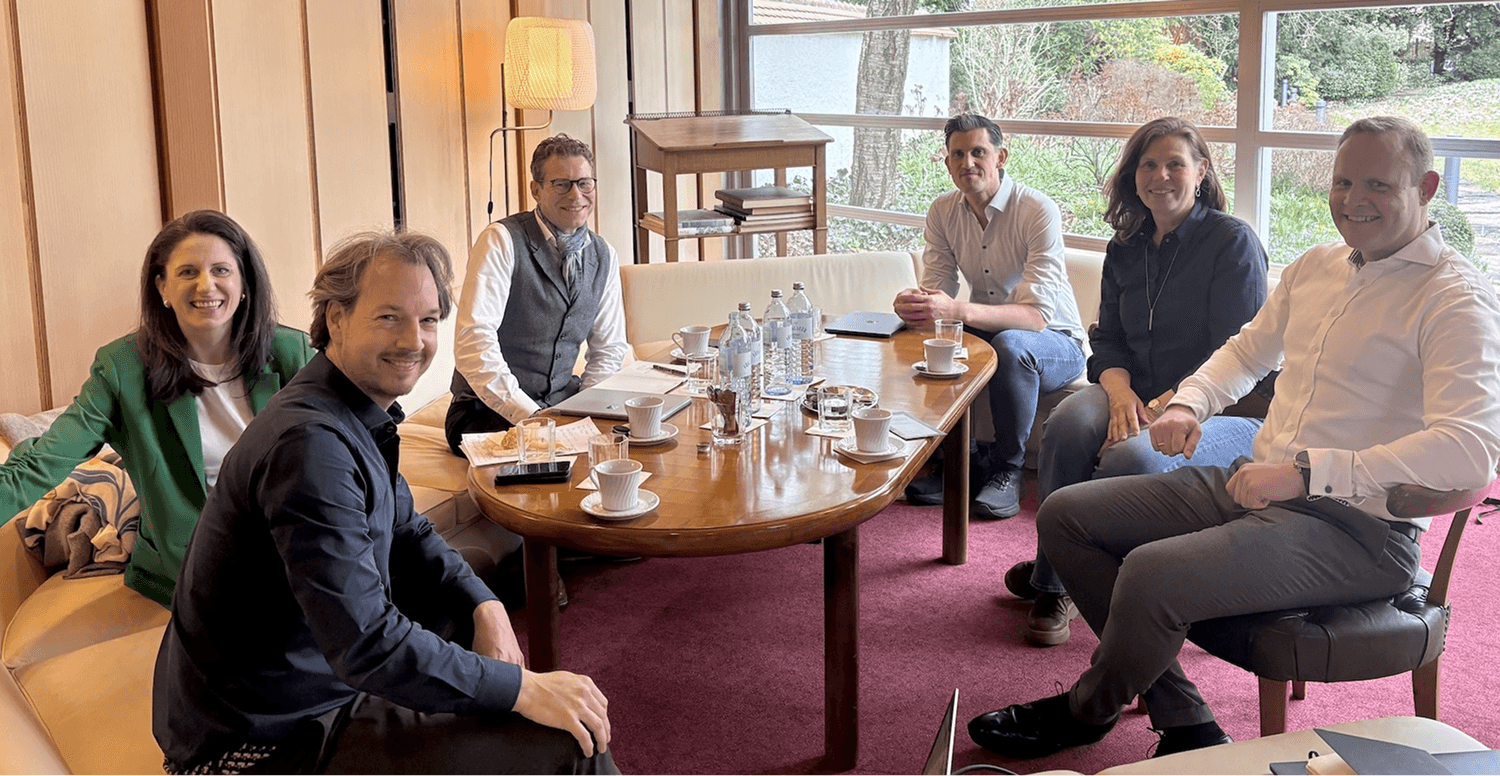
By comparison: in the digital structure at bcause with a 4% net return (advisory board in the picture) and without additional distribution fees or fixed costs, the capital requirement is drastically reduced. Here, around 250,000 euros are sufficient to enable the same 10,000 euros in funding.
The difference is around 400,000 euros. This is not a detail. It is a structural problem. Or to put it another way: there is no shortage of money. There is a shortage of efficient structures that translate it into impact.
Offer for non-profit organizations
bcause enables non-profit organizations to collect and earn interest on donations digitally, manage them centrally, and retrieve them with pinpoint accuracy. Fundraising and the use of funds no longer work separately, but hand in hand.
Current example: The Sozialheld*innen champion an accessible society with projects like Wheelmap.org and are now using bcause as their new fundraising platform. Here, your donations not only earn interest, but the association also becomes part of an engaged donor community and benefits from numerous foundations on bcause.
⛏️ Needs & Leads
The Summit of the Living Society invites you to explore abundance and wealth from April 29 to May 03, 2026.
The new cinema film “Wir Erben” premieres on Thursday, April 23, 2026 at 8 pm at the Delphi Lux in Berlin. I have free tickets to give away.
For those who suspect they might want to see me in a tuxedo: the evening gala of the German Startup Awards takes place on May 21st.
bcause is currently advertising a job to support non-profit organizations in using our platform.
Ashoka Germany is currently looking for a partner for strategic growth and philanthropy. You can access the job posting here.
Please feel free to write to me with your needs and leads.
💡 MORE FROM FELIX
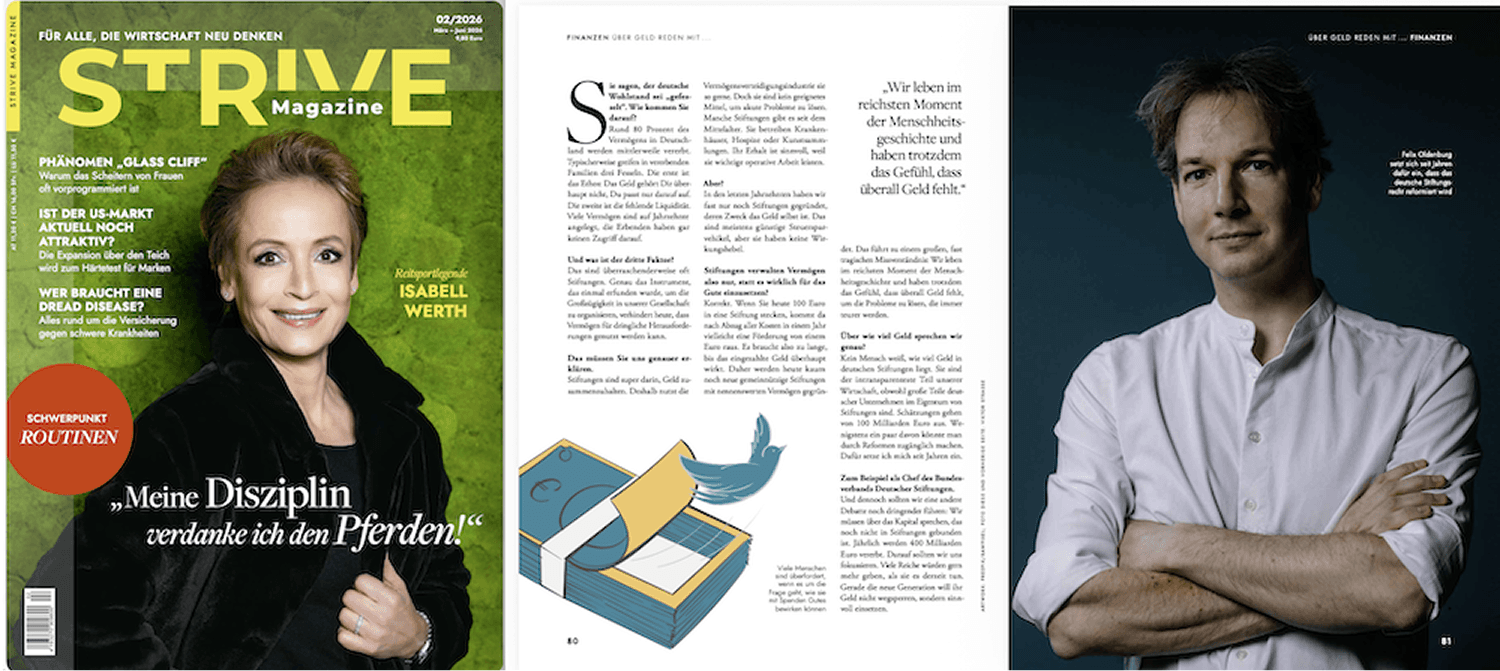
It is a special honor to read a long interview with me in STRIVE magazine starting March 26 (see image, PDF on request).
My columns “How asset managers are losing the next generation” and “Where to go with the privileges?” were published in the Handelsblatt.
My Podcast “Das Neue Geben” is about to be relaunched. Until then, there continue to be interesting guest episodes.
📅 Upcoming Appearances:
April 16 Personal exchange with Maria Furtwängler at Club Neues Geben. (Open to all who give starting from 5-digit sums. If interested, message katharina.bauch@bcause.com)
May 21 German Foundation Day, Hamburg
May 21 German Startup Awards, Berlin
June 1-3 German Fundraising Congress, Berlin
July 17 United Philanthropy Forum, Washington DC
Felix Oldenburg is an initiator in the field of social entrepreneurship and foundations. 🔗 Order the book "Der gefesselte Wohlstand" here 🎧 Or as an audiobook while jogging, cooking, driving... 📱On Instagram and LinkedIn for daily thoughts and impulses for discussion.
Did you like this issue? 👉 Recommend Das Neue Geben further and help us grow to 10,000 readers. 📮 Feedback? Write to me at fo@bcause.com 🔔 Whitelist this email so no issues end up in spam
Felix Oldenburg CEO bcause · Board member gut.org · Author "Der gefesselte Wohlstand"
Newsletter
So much is written. About everything. Except about giving. Every day I meet people who want to and can give more. Ideas and organizations that make a difference.
In my newsletter, I talk about topics that otherwise remain unexplained: Why people give or don't, which paths and wrong turns they take, how the market of giving works - with surprising numbers, inspiring portraits, and provocative ideas.